
What a Cedar City Resident Lookup Covers
A Cedar City resident lookup is a comparison across records, not a single name box. Property accounts can confirm an indexed owner and mailing trail. Utah voter data may show public registration fields. Xchange can identify a party, case type, filing date, and court location. Vital indexes can point to a birth, death, marriage, or divorce record. Commerce and DOPL can establish a business or credential link. Each result answers a different question.
| Record | What It Confirms | Where to Search | Access |
|---|---|---|---|
| Property account | Indexed owner, parcel, value, mailing | Iron County EagleWeb | Free search; image limits |
| Voter registration | Public address, district, status, vote history | Utah Vote Search | Protected fields withheld |
| Court records | Case number, parties, filing, history | Utah Courts Xchange | Account and document fees |
| Vital records | Birth, death, marriage, divorce clues | OVRS and local desk | Opening and relationship rules |
| Licenses / entities | Credential, principal, agent, status | DOPL / Commerce | Free lookups; list fees vary |
Choose the first record by the clue available. Use an address for the parcel layer, a case number for court, a date and relationship for vital records, and an organization or license number for Commerce or DOPL. A name alone is broad. Add Cedar City, Iron County, a ZIP, an age range, or a date before judging a match.
Verifying a Cedar City Resident’s Records
Verification means testing the same person across independent fields. Start with the name’s spelling and any known Cedar City address. Compare the parcel or voter result with the court location, case date, occupation, family link, or newspaper notice. Keep public indexes separate from certified copies. An index helps locate a record. A certified copy is an official copy issued by the custodian under the access rule.
- Anchor the name to an address, parcel, ZIP, organization, or dated Cedar City source.
- Run Xchange by county or court, party name, case type, case number, birth date, citation, or date range.
- Test maiden, married, middle-initial, and spelling variants against a vital index, newspaper, cemetery, or archive finding aid.
- Order a certified copy only when the relationship, direct interest, identification, or other access rule is met.
- Docket
- The court’s running case record, including filings, events, parties, and dispositions.
- Index versus image
- An index points to a record; an image is the document itself and may require payment or office access.
- Certified copy
- A custodian-issued copy carrying the certification required for an authorized use.
Cedar City Xchange Name Search
Utah Courts Xchange offers more than a surname match. Narrow by Fifth District or Justice Court, county, case type, case number, citation, filing range, and, when available, birth date. The result columns include county, court location, case type, case number, filing date, first and last party names, birth date, party code, and case-history or document links.
A guest account costs $10 once. Searches are $0.20, and documents are $1 each regardless of page count. Public terminals are available at many district courts and the Utah State Law Library. Electronic district documents generally begin July 1, 2010, while most courts used CORIS by the end of 1998. Justice Court migration and older conversions can leave thinner detail.
The Utah Courts Xchange help page is the linked source for the fields, result columns, and access notes in this search.
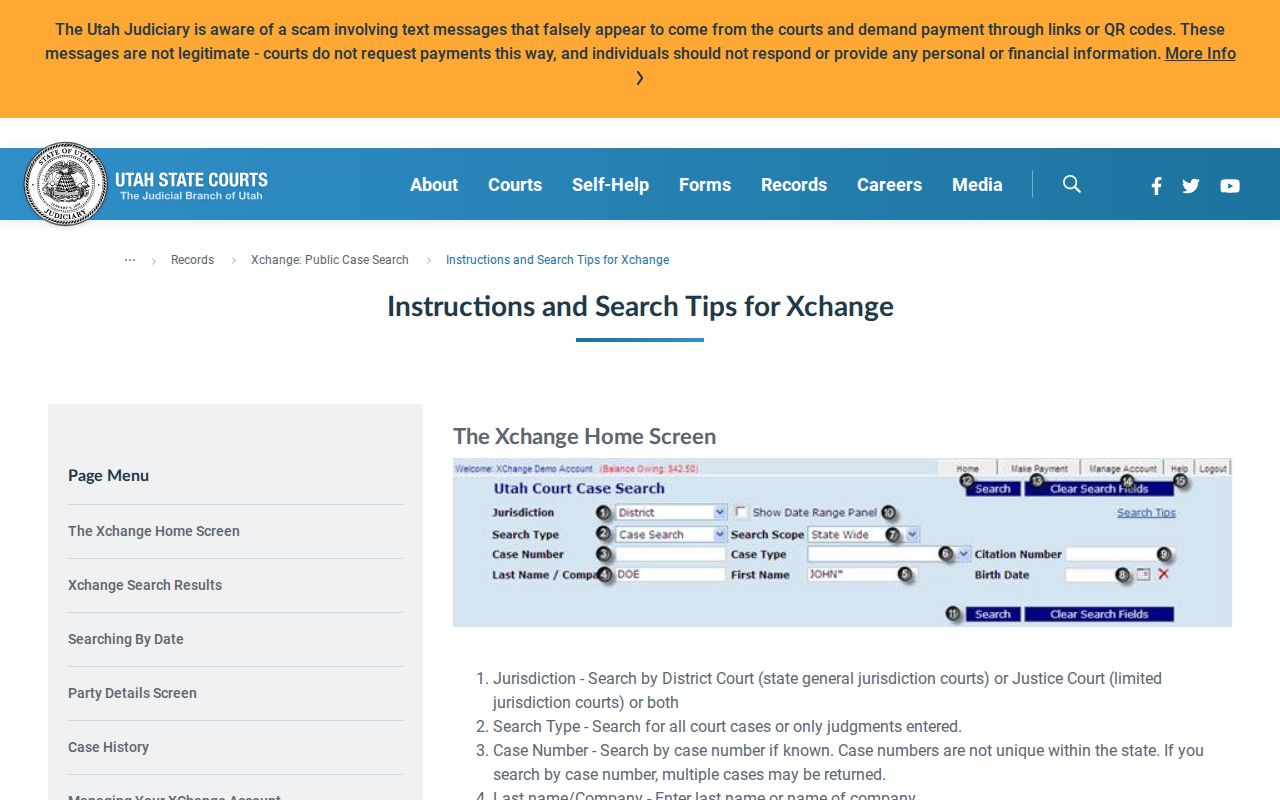
Use the case number and court location to distinguish a same-name result, then check the case history or document link separately.
Cedar City Property Connection
Iron County EagleWeb Account Search and the public GIS parcel layer can anchor a name to an indexed owner, parcel, account, mailing address, legal reference, value, or tax field. The connection is about a property record. A Bountiful mailing address can appear on a Cedar City parcel, and a blank situs field can occur in a returned GIS row.
Save the parcel and account before looking elsewhere. Then compare the legal reference with the Recorder’s Document Search. If the name is an LLC, check Utah Commerce for the entity or principal relationship. These steps can disambiguate two people without turning a filing address into a claim about a private residence.
The Iron County EagleWeb account page is the linked source for the property fields used as a name-search anchor.
Keep the property relationship labeled as an indexed owner or account connection, not as proof of occupancy.
Cedar City Vital Indexes
Utah OVRS and Southwest Utah Public Health handle eligible birth and death certificates, while marriage and divorce abstracts follow the state request route and court files remain with the court. Birth records open publicly after 100 years, death records after 50, and marriage or divorce after 75 under Utah Code §26B-8-125. Earlier certified access requires a permitted relationship or documented interest.
The birth form asks for relationship, applicant contact, number of certificates, signature, and identification or documentary proof. The current initial fee is $22, with $10 for an additional copy and a possible expedited fee. The death form asks for the deceased’s full name, date and place of death, birth details, family fields, applicant relationship, purpose, copies, ID, and payment. Its initial fee is $30, with $10 for an additional copy. Index visibility and certificate eligibility are different things.
Marriage and divorce abstracts use a separate form. The research inventory covers Utah marriage or divorce events from 1978-2010 in the older range, with marriage records from 2011-present also described, and lists an $18 initial fee plus $10 for another copy. Court divorce files are separate from the OVRS abstract. Check the record type and event date before choosing a request path.
Keep the event date and record custodian in the research notes.
The Utah vital-records page is the linked source for confirming the current application route before requesting a Cedar City event record.
Confirm eligibility and the event type with the custodian before treating a visible index as proof that a certified copy is available.
Cedar City Heir and Classmate Search
Family and reunion questions often need a record mix. A public Xchange case history can point to a probate or party relationship, while a deed may show a later transfer. SUU Archives’ MS-153 and MS-031 collections hold funeral programs, reunions, school, historical-society, and community-organization material. The Cedar City Library holds family and place histories, and local newspapers carry obituaries, legal notices, marriages, and school events.
A student may be absent from a census household and still appear in a Southern Utah University paper, yearbook, or program. Use the dated campus item with a separate address, property, or family source. A family narrative can supply a lead and a relationship. It should not be treated as a civil record without confirmation.
Cedar City License and Entity Records
Utah DOPL License Lookup accepts a license number, four-digit number, and professional or entity type. Result details can show a licensee, credential, status, issue or expiration information, and discipline links. Commerce searches entities, principals, registered agents, and UCC filings. A business-list request can filter entity type, NAICS, ZIP, recent changes, new registrations, and status.
These records help test an affiliation, not a home address. A UCC debtor or secured-party address is a filing field. A DOPL construction registry result is limited to active opt-in construction businesses. Use the record’s own date and purpose when matching a Cedar City name.
Cedar City GRAMA Record Request
When a portal ends, GRAMA provides a written route for an existing government record. A request should name the requester, mailing address, phone if available, and a specific record description. The agency does not have to answer a broad question or create a new record. File through Utah’s Open Records Portal or the custodian by email, mail, fax, or in person.
Ordinary response time can reach ten business days. Inspection is generally free, while copies and staff work may cost under Utah Code §§63G-2-203 and 63G-2-204. Iron County Justice Court’s local form asks for contact details, the subject’s legal name and birth date, case or citation number, violation date, record type, delivery method, and ID when required. Email delivery can be no cost; copy, certification, audio, postage, and research charges differ.
The local Justice Court form can request a docket or case history, arraignment or in-court minutes, formal information, judgment and sentence, notices, motions and orders, citations, discovery, plea agreements, disposition, audio, or another specified record. A requester may need to select a status such as public, subject, parent or guardian, provider, power of attorney, subpoena, or court order. Those choices matter because a public case-history line does not open every document.
For a wrong name or address, contact the custodian rather than trying to correct a copied result in another place. The Utah voter route, vital office, Recorder, court clerk, and property office each control a different record. A correction request should identify the record, source date, disputed field, and supporting document. GRAMA can request an existing record, but it does not require an agency to create a new identity match.
Cedar City Resident Lookup Legal Limits
Utah records can be public, private, controlled, protected, or redacted. Sealed, expunged, juvenile, adoption, civil-commitment, and other protected court matters are not ordinary name-search results. Safe at Home shields a certified participant’s actual residence and related location fields behind a substitute address. Voter records also withhold at-risk information. DMV data is restricted under the federal DPPA.
Lawful use. A Cedar City resident lookup supports personal, lawful research, genealogy, reconnection, and records verification. Do not use information found through it to stalk, harass, intimidate, or harm another person.